In the public eye, an organizational crisis at a Public Housing Authority (PHA) looks like a sudden explosion—a scathing federal audit, a front-page scandal, or the abrupt departure of an executive. But to those of us who study the structural integrity of public institutions, these events are not the beginning of the end; they are the end of a very long, very quiet beginning.
The reality, as evidenced by the research of The Beatty Group, is that institutional failure is a slow-motion collapse. It is the cumulative result of “strategic drift”—a process where organizational discipline doesn’t break so much as it dissolves. While the headlines focus on the eventual fire, the true crisis is found in the years of smoldering inertia that preceded it.
1. Crises are Born in Silence, Not Scandals
The most dangerous phase of organizational decline is the one that makes no noise. In public administration, we often mistake “quiet” for “stable.” However, governance decline begins when small inconsistencies in decision-making are allowed to become the new normal.
When a board stops monitoring its own discipline, the organization’s capacity for revitalization—the muscle memory required to modernize operations or reposition a portfolio—begins to atrophy. By the time a PHA is designated as “troubled,” the rot has usually reached the foundation. As the foundational research notes:
Housing authority crises rarely begin with a headline. They do not start with a troubled designation, an audit finding, executive turnover, or public controversy. Those events are late-stage symptoms.
2. The Fatal “Strategic Drift” of Decision Paralysis
One of the earliest “canaries in the coal mine” is Decision Paralysis. This occurs when a board descends from strategic leadership into reactive management. High-impact decisions regarding capital planning or resident services are repeatedly postponed, not because of a lack of data, but because of a lack of consensus.
This isn’t just a boardroom inconvenience; it has a devastating human cost. Every month a capital plan is stalled is a month that a leaky roof remains unpatched or a heating system remains unreliable. These delays compound into the quiet decay of the hallway and the physical deterioration of the properties. In the world of public housing, a stalled decision in the boardroom eventually manifests as the weight of a work order that never comes for a resident in need.
3. When Boundaries Blur, Morale and Safety Break Down
Institutional instability is often a product of “blurred lines.” When board members step outside their strategic lane and begin micromanaging operational matters, they create a culture of “mixed messages.”
This upstream confusion inevitably becomes downstream despair. When staff are forced to reconcile competing instructions from board members and executive leadership, their focus shifts from execution to conflict management. Procurement slows, capital improvements are delayed, and the residents experience the fallout through inconsistent communication and uneven access to basic services. When the governance structure loses its shape, the safety and morale of the entire community soon follow.
4. The Dangerous Grace of “Policy Drift”
Failure is rarely born of intentional disregard for the law; it is born of Policy Drift—the gradual, well-intentioned relaxation of established rules. It starts with an undocumented exception for one vendor or a minor shortcut in rent calculation.
Regulators and auditors do not look for isolated mistakes; they look for patterns of inconsistency. When policies are followed only when convenient, it creates a systemic inequity among residents. Vulnerable families lose faith in the institution’s fairness when they see rules applied arbitrarily. As the source context highlights:
Policy drift is gradual relaxation, not intentional disregard. That gradual relaxation, however, signals instability and accelerates portfolio deterioration.
5. Why “Operation-Only” Fixes are Doomed to Fail
When an authority hits a breaking point, the instinct is often to “hire a new director” or “wait for more funding.” But the Beatty Group Transformation System reveals a more rigorous truth: operational fixes cannot cure governance failures.
A strategic advisor knows that property redevelopment succeeds only when governance, operations, and finance are modernized together. Funding alone cannot bridge an accountability gap, and a new leader cannot overcome a legacy of policy drift if the board’s underlying architecture remains broken. Sustainable transformation requires a systems-based approach that treats the PHA as a unified enterprise rather than a collection of siloed departments.
6. Reimagining the PHA as a Mission-Driven Enterprise
We are currently at a defining crossroads for public housing. The shift from traditional models to Section 8-based platforms and the Rental Assistance Demonstration (RAD) represents more than a funding change; it is an opportunity to build institutions that are “built to last.”
The future of the sector belongs to authorities that can evolve from being “landlords of last resort” into enterprising stewards of community revitalization. This means leveraging private capital, modernizing asset management, and seeing resident services not as an “extra,” but as a core driver of community wealth. The goal is to create institutions that are financially sound and strategically agile enough to survive the next generation of federal policy shifts.
A Call for Proactive Transformation
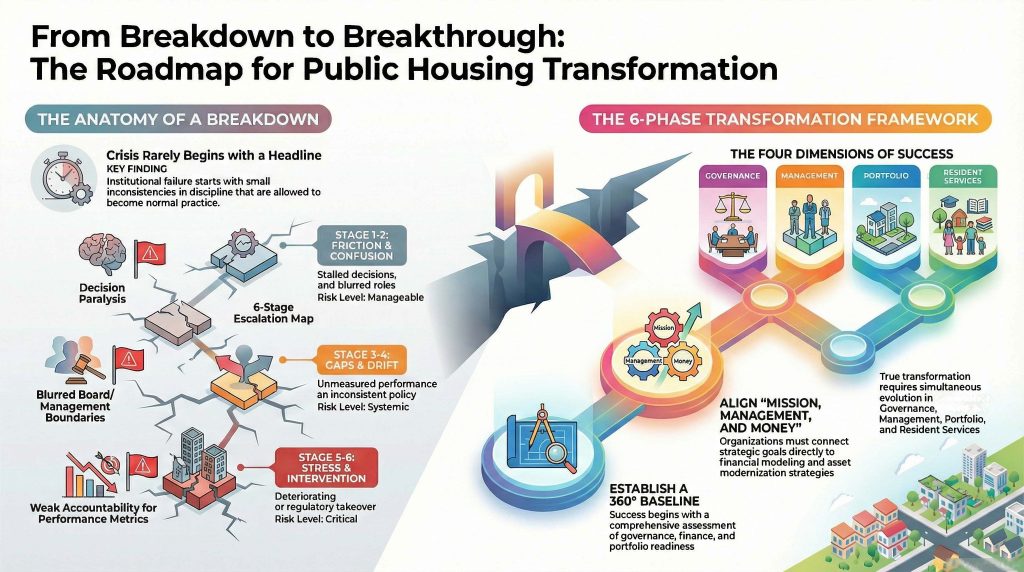
The Beatty Group’s “Escalation Map” provides a sobering look at how institutions die. It begins with Stage 1 (Friction) and Stage 2 (Role Confusion), eventually passing through Stage 4 (Policy Drift) before hitting the terminal Stage 6 (External Intervention).
The most critical insight for any housing leader is this: correction is most manageable during Stages 1 through 3 (Friction, Confusion, and Gaps). Once an organization hits Stage 5, characterized by financial stress and portfolio underperformance, the window for self-correction begins to slam shut.
Transformation is no longer optional; it is an existential imperative. Current leaders must ask themselves: Are we monitoring our governance discipline closely enough to see the cracks before they become chasms? The choice is simple: intervene now while you still own the solution, or wait until a solution is imposed upon you by outside forces. True leadership is finding the discipline to fix the silence before it becomes a headline.